
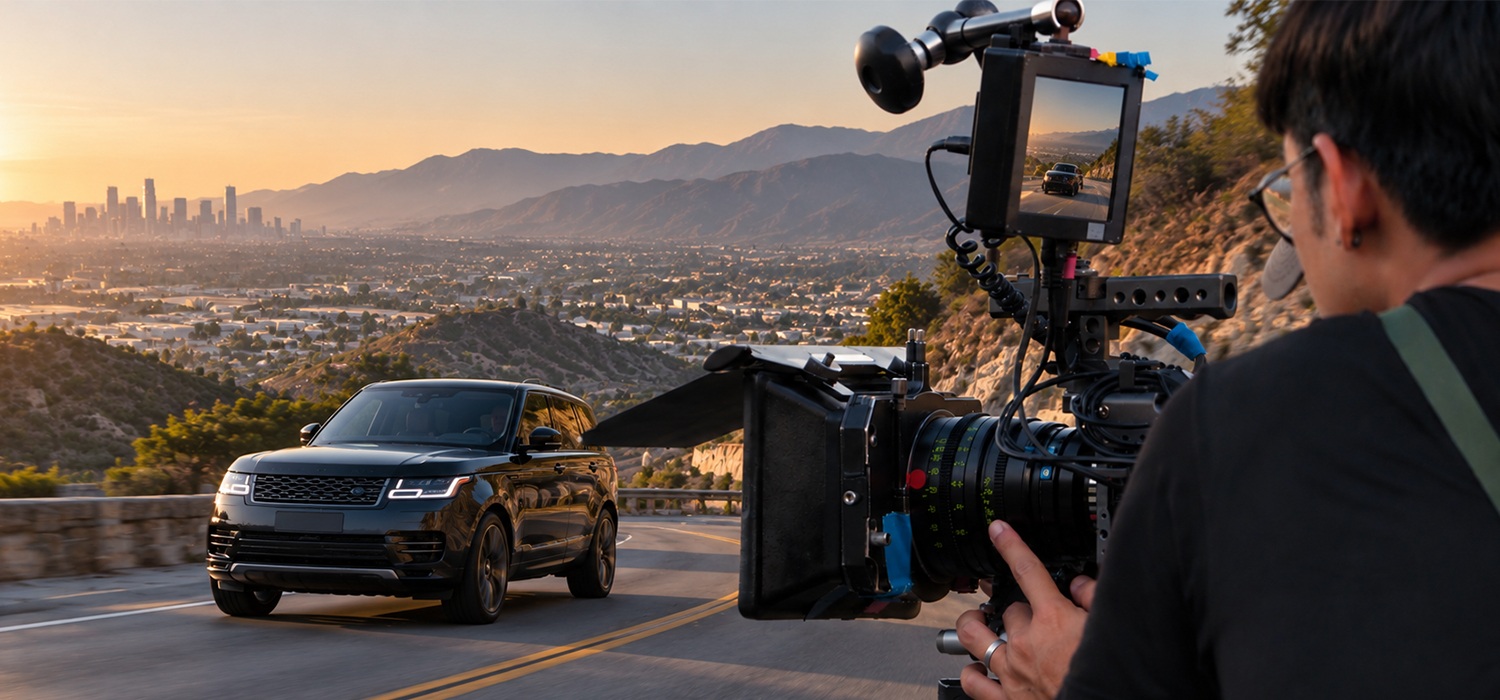
Show up at a car commercial set in Los Angeles at 5 a.m. and you’ll usually find two dozen trucks squeezed onto a residential street and a hero car that hasn’t turned a wheel yet, because the traffic control plan got revised at midnight.
Now drive 40 miles east.
More car commercials are shot in the Inland Empire than most people outside the industry realize, and the reasons are practical. We run our production work out of Rancho Cucamonga, so we see the scout vans rolling down Foothill Boulevard every season. Here’s what’s pulling them out here, and where the catches are.
The roads look like a car ad before you add a car
A car spot lives or dies on the road. You need clean pavement with a backdrop that says something, and enough length for a camera car to run alongside at speed without cutting the take short.
Los Angeles has famous roads. Angeles Crest and Mulholland have been in more ads than anyone can count, which is part of the problem. Viewers have seen those curves. Brands are tired of them too.
The Inland Empire gives you real variety within about an hour’s drive:
- Foothill Boulevard (historic Route 66)through Rancho Cucamonga and Upland, for a wide suburban-Americana look with the San Gabriel Mountains filling the frame.
- Mount Baldy Road, which climbs out of the foothills into switchbacks and pines. Good for SUV and performance spots.
- Rim of the World Highway (Route 18)toward Lake Arrowhead and Big Bear, with drop-offs and long valley views.
- Desert two-lanes out toward the Mojave, where you can frame a truck against nothing but sky and creosote.
Most briefs only need one hero road and a backup, so that list goes a long way.
Then there’s the winter shot every automotive DP wants and few actually get: palm trees in the foreground, snow on Cucamonga Peak behind them, a sedan sliding through the middle. On a clear January morning you can find that from a handful of streets north of the 210. You won’t find it in Santa Monica.
Permits: slower in LA, simpler here (mostly)
Anyone who has filmed in Los Angeles knows FilmLA. It’s professional and it works. But the city and county are heavily filmed, and some neighborhoods have had enough. Certain areas require resident notification or signature surveys before you can shoot, and busy corridors come with tighter limits on hours and parking.
Car commercials make this harder than most shoots. You aren’t parked in one spot filming dialogue. You’re asking to control traffic on a moving stretch of road, sometimes with a process trailer, sometimes at speed. Every one of those requests adds review time.
Out here, cities and both counties deal with far less filming traffic. The Inland Empire Film Commission helps productions in Riverside and San Bernardino counties reach the right local offices, and cities like Rancho Cucamonga run their own permit process. Smaller permit offices tend to pick up the phone. That matters a lot when the agency moves your shoot date by three days.
Now the honest part. If your road is a state highway (Route 18, for example), you’re working with Caltrans and the California Film Commission regardless of county, and traffic control there means the California Highway Patrol. Mountain roads inside the national forest bring the Forest Service into the conversation as well. Leaving LA doesn’t make permits disappear. What it usually gets you is fewer competing productions and a shorter queue.
Staging is where the budget actually moves
Ask a line producer what went over on their last car shoot and they rarely say “the road.” They say basecamp.
A typical automotive spot needs room for picture cars (often several identical units in case one gets scratched), camera cars, a process trailer, grip and electric trucks, talent trailers, catering and crew parking. In LA that footprint turns into rented lots, shuttle vans and parking tickets.
The Inland Empire happens to be one of the biggest warehouse and logistics hubs in the country. Ontario, Fontana and Rancho Cucamonga are full of large paved lots and industrial parcels, and plenty of them sit quiet on weekends. With the right agreement from the owner, you can park a full automotive unit, prep hero cars under shade and still be ten minutes from your road. Those lots earn their keep on camera too. A big empty surface is a controlled place for tight car-to-car moves or the slow-motion wheel insert every spot seems to need. No street closure required.
Getting in and out is easy. The 10, the 15, the 210 and the 60 all cross the region, and Ontario International Airport lets an agency team fly in without ever touching LAX
Light, heat and wind
We learned this one the hard way. Summer afternoons here get hot enough that heat shimmer comes off a black hood and shows up on camera, and a crew is worn out by 2 p.m. So we schedule driving shots for early morning and the last two hours of daylight. That’s when the light looks best anyway.
In fall, watch the Santa Ana forecast. Those winds clear the haze and give you crisp mountain backdrops. They also throw dust across open roads and flatten anything you forgot to sandbag.
So should your next car commercial shoot here?
If your spot needs one recognizable LA landmark, stay in LA. If it needs open roads and enough room to stage a full automotive unit without fighting for every parking space, the Inland Empire deserves a scout.
HighShot Cinematics is based in Rancho Cucamonga and shoots automotive and commercial video across Southern California. Planning a car spot? Get in touch, and we’ll give you a straight local read on what’s realistic for your dates.