
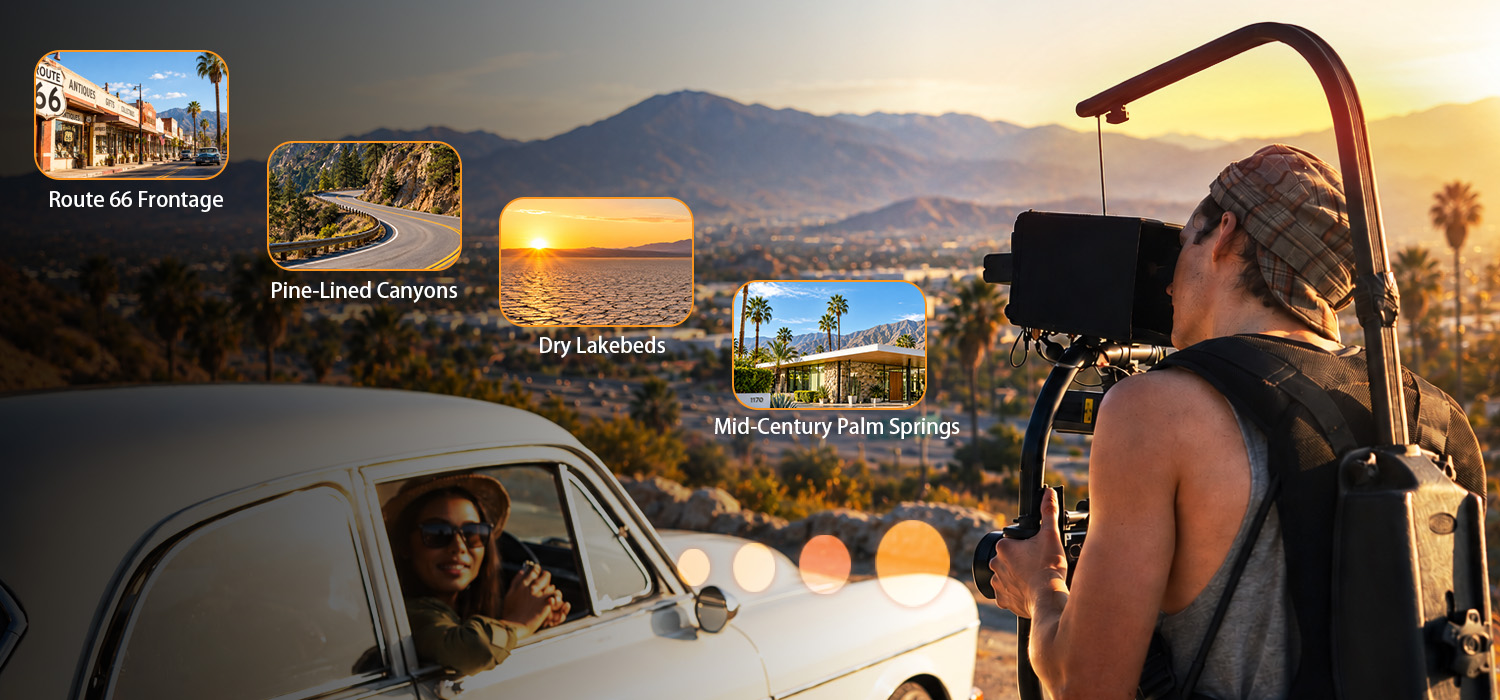
The Inland Empire gets overlooked by people who’ve only seen it from the 10. Spend a week scouting, though, and you’ll find more usable looks for car and brand work than most regions in the country: Route 66 frontage, pine-lined canyon switchbacks, dry lakebeds that run to the horizon, mid-century Palm Springs, wine country and miles of clean industrial concrete.
Here’s the shortlist we keep coming back to at HighShot Cinematics, working out of Rancho Cucamonga. For each Inland Empire filming location we’ve noted what it’s good for and who you’ll be talking to about permits.
Urban and Americana
Route 66 along Foothill Boulevard
Foothill Boulevard through Rancho Cucamonga follows the old Route 66 alignment and still has pockets of that roadside Americana, including the restored Cucamonga Service Station. It suits classic cars, heritage campaigns and dealership spots that want a bit of nostalgia. City streets mean a city permit, and businesses along the route need their own location agreements.
Industrial corridors in Ontario, Fontana and Rancho Cucamonga
The Inland Empire is one of the country’s biggest logistics hubs, and that gives you something LA struggles to offer: wide, clean, nearly empty streets on weekend mornings, lined with enormous concrete walls. It’s a great backdrop for urban car work, EV launches, fleet vehicles and brand films for logistics companies. Warehouse frontage is private property, so access goes through the owner.
Downtown Riverside
Downtown Riverside mixes Spanish Revival architecture with historic civic buildings, the Mission Inn among them. It works for luxury sedans, lifestyle stills and brand stories that need warmth and texture instead of glass towers.
Mountains and canyons
Mount Baldy Road and Lytle Creek
Twenty or thirty minutes from Rancho Cucamonga you’re climbing into switchbacks, rock cuts and pine forest. These roads are ideal for performance cars, SUVs and anything that needs to look good carving corners. They sit on National Forest land, so plan for a Forest Service permit. We get into the shooting side of canyon roads in The Rig, the Roads and the Speeds.
Cajon Pass and Mormon Rocks
The tilted sandstone of Mormon Rocks near Cajon Pass is one of the most dramatic backdrops in Southern California, and it’s barely off the freeway. Freight trains run through the pass too, which adds scale for truck and commercial vehicle work.
High desert
El Mirage Dry Lake
A flat, pale surface that seems to go on forever. El Mirage is the classic spot for side-by-side speed runs, clean horizon shots and minimalist, product-style car imagery. It’s BLM land run as an off-highway vehicle area, so book permits early and check the surface after any rain.
Lucerne, Johnson and Stoddard valleys
Rougher and rockier, with buttes, washes and dirt tracks. This is truck, off-road and overlanding territory, and Johnson Valley is home ground for the King of the Hammers race. It’s a natural fit for tire brands, lifted builds and adventure lifestyle campaigns.
Joshua Tree National Park
Instantly recognizable and hugely popular, which is exactly why it’s tightly controlled. Only specific areas of the park are open to filming and National Park Service rules apply, so confirm your spot before you build a storyboard around it.
Desert resort and wine country
Palm Springs and the Coachella Valley
Mid-century modern homes, palm-lined boulevards, wind farms and mountain backdrops make this a favorite for luxury automotive, fashion and lifestyle brands. Summer heat is serious out here, so most outdoor car work happens between late fall and spring.
Temecula Valley
Rolling vineyards and winding rural roads in southwest Riverside County. It’s a strong fit for premium sedans, convertibles, hospitality clients and brand films that want a softer, golden look.
Scout at the hour you’ll shoot
Location photos lie, usually by accident. A lakebed photographed at noon looks nothing like it does at 6 a.m., and a canyon that felt wide open on a Tuesday can be full of cyclists by Saturday. Whenever possible we scout at the same time of day and on the same day of the week as the planned shoot, and we drive every road in both directions. We’re looking for turnaround points, places to stage trucks, cell coverage (patchy in the canyons and the desert) and the nearest restrooms, which matter more than anyone admits on a twelve-hour day.
Matching the location to the brief
Picking a location starts with the story, not the prettiest picture. A few pairings that work again and again:
- Performance launch: canyon roads for handling, a dry lakebed for speed.
- EV or tech brand: industrial corridors at dawn, clean and graphic.
- Truck and off-road: Johnson or Stoddard Valley, with FPV chasing the dust.
- Luxury and lifestyle: Palm Springs or Temecula at golden hour.
- Dealership and heritage: Route 66 frontage or downtown Riverside.
Many of these shoots combine our camera car service with FPV drone coverage and ground-level photography and videography, so stills, motion and social content all come out of the same day on location.
Permits: who you’ll be dealing with
The short version. Unincorporated San Bernardino County is handled by the county film commission, which takes applications online. Riverside County’s film office is run by Inland Empire Film Services, which also handles permits, traffic control and neighborhood notifications for many cities across both counties. National Forest roads need Forest Service permits, most open desert means the BLM, and Joshua Tree means the National Park Service.
BLM permits in particular can take 30 to 60 days or longer, so book the desert first, not last. If you’d rather not juggle four agencies, we can build the permit timeline into your full-scale production plan from day one.